Showing posts with label Paris. Show all posts

Friday, November 20, 2015

From Eric Emmanuel Schmitt — “Question on the Night of the 13th of November, 2015”

French writer and philosopher Eric Emmanuel Schmitt, puts into question form what many are wondering following the recent attacks in Paris. For when words fail us in the face of horror...

Question on the Night of the 13th of November, 2015”

Really, what is it that these fanatics don’t like?
That we might drink a nice wine while sitting on the terrace of a cafe.
That we might look at the pretty girls as they walk by in short dresses.
That we might eat for hours all the while talking about cuisine.
That we might believe in God in our own way.
That we might not believe in God.
That we might all read books, and especially the book that we want.
That we might be sexually liberated, joyfully, insouciantly, lovingly.
That we might listen to different kinds of music, both high brow and low brow.
That we might have lovers, friends, acquaintances, neighbors, who do not come from where we come from, nor have the same color skin, nor even the same way of thinking as we do.
That we might joke about everything, about politicians, about men of the church, about beliefs, about ourselves…
That we might enjoy just being there….

Alfred Eisenstaedt  1963


Well then, they hit the right targets, these terrorists: because they don’t love life, they won’t love us. A fanatic once said: “You can’t stop us because we are already dead.” Let’s admit it — he was right.
As for me, though, I’m definitely volunteering to join the party of Life.

And, finally, I would like to borrow these lines from Aragon, which celebrate youth:

“It’s nicer out than it’s ever been
Fresh like the water under the oar
Weather glorious as a woman
Weather to damn your soul
It’s nicer out than ever weather for laughing and running
Weather not for dying
Weather for fearing for the worst
It’s nicer out than it’s ever been
Too bad for the man whose blood is gloomy
The sun backlit by the shade
Will stride over the rubble.”

(Translation, Aiken, 2015) 

"QUESTION SUR LA NUIT DU 13 NOVEMBRE 2015"
Au fond, qu’est-ce qu’ils n’aiment pas, ces fanatiques ?
Qu’on boive du bon vin à la terrasse d’un café.

Qu’on regarde les jolies filles qui passent en jupe courte. 

Qu’on mange durant des heures en parlant de cuisine.

Qu’on croie en Dieu à notre façon.

Qu’on ne croie pas en Dieu.

Qu’on lise tous des livres, et surtout le livre qu’on veut.

Qu’on puisse avoir une sexualité libre, joyeuse, insouciante, amoureuse.

Qu’on écoute des musiques diverses, des musiques échevelées autant que des musiques bien peignées.

Qu’on puisse avoir des amours, des amis, des copains, des voisins, qui n’ont ni la même origine, ni la même peau, ni la même pensée que nous.

Qu’on plaisante de tout, des politiciens, des hommes d’église, des croyances, de nous-mêmes…

Qu’on jouisse tout simplement d’être là…
Alors, ils ne se sont pas trompés de cible, les terroristes : puisqu’ils n’aiment pas la vie, ils ne nous aimeront pas. Un fanatique a dit un jour : « Vous ne pouvez pas nous arrêter parce que nous sommes déjà morts. » Là, reconnaissons qu’il avait raison. 
En revanche, moi, je m’inscris définitivement au parti de la vie. 
Et pour finir, j’ai envie de citer ces vers d’Aragon qui célèbrent la jeunesse :

"Il fait beau comme jamais
Frais comme l'eau sous la rame
Un temps fort comme une femme
Un temps à damner son âme
Il fait beau comme jamais un temps à rire et courir
Un temps à ne pas mourir
Un temps à craindre le pire
Il fait beau comme jamais
Tant pis pour l'homme au sang sombre
Le soleil prouvé par l'ombre
Enjambera les décombres."
 

Sunday, November 15, 2015

Paris and Charlie Hebdo - A Wager on History (repost from April 1, 2015)


The new century is yet in its adolescence, and in a moment of historical Necessity the rallying cry – “Je suis Charlie” – has been taken up again, but in contemporary translation, to unite “free hearts, free foreheads” around a still young idea, only little more than two centuries old, that men will be happier when allowed to live out their lives in freedom, that liberty and equality will yield a greater harvest of human joy and fulfillment than any form of tyranny, whether of religion or of state. To borrow Abraham Lincoln’s rhythms—we are now engaged in an historical wager, to test whether Men so conceived and so dedicated in Liberty, can long endure.
     The following text is Phrontisterion’s translation of Riss’s Editorial from February 25, 2015 (CH #1179), the second edition of Charlie Hebdo to appear on the newsstands after the slaughter of its editorial staff by religious fundamentalists in Paris on February 7th.

Editorial:
For a long time I thought that the worst thing that could happen to a political cartoonist would be to be poisoned, which is what happened to Daumier and Philipon under the reign of the old fool Louis-Philippe. So when Charb, Luz, or myself, young cartoonists, would propose some sketch to satiric newspapers at the beginning of the 1990s, there was nothing to fear, because the benevolent angel of our craft was hovering just above our heads: the sacrosanct Freedom of Expression.

With just our cartoons we were hoping to laugh and to make others laugh; but after several years, and after drawing all the famous celebrities in laughable situations, a question came to our minds: to caricature, to make drawings—at the end of the day what is the purpose of it? After all, a drawing is just a drawing. Just a little scribbled something that tries to be humorous all the while hoping to get someone to think. To laugh and to make one think: this is what makes an ideal caricature! The pleasure of surprising the reader by taking an unusual point of view, by doing a little side-step that obliges the reader to look at things obliquely, from an angle that is unfamiliar, different from mainstream seeing.  The exaggeration and the embellishment, which are the much-criticized stock in trade of the political cartoonists at “Charlie Hebdo,” are nothing more than a means of exploring roads less traveled by.

It is perhaps this that the assassins of January 7th could not tolerate, those who, if truth be told, never really tried to do anything. They just allowed themselves to be coddled by the comforts of a religion that already has all the responses, and that allows one to dispense with thinking and doubting; because doubt is the worst enemy of religion. There can be no more doubting when someone has chosen to enter into a newspaper office in order to kill everyone.

The cartoonists and the editors at “Charlie,” on the other hand, spend all their time doubting. About everything, and especially about themselves, their talent, and their inspiration. Which sometimes makes them infuriating. Wolinski wondered after the fire in 2011: “Have we perhaps gone too far?” Only an honest man asks this type of question. Never a killer. Wolinski had the courage to put his his own doubts on display. He chose to make the expression of his vulnerability an art. This is why a cartoonist will never become a killer, and why it is dishonest to make the violence of the assassins comparable to the so-called “provocations” of the cartoonists by proclaiming, “they were asking for it.”

In order to doubt, though, one needs others, all those who do not think like you do. How boring it would be if everyone thought like us! The killers of January 7th must sure have lived in a sad world… an inflexible world where any head that is out of place gets decapitated, where any discordant voice is cut off. So, imagine, for these of little brain, even just the idea of making pint-sized cartoons about the prophet! These miserable wretches threw away the lives of others in order to forget that they had thrown away their own. As Luz wrote on the front cover of “Charlie,” we should almost forgive them just for being what little they were.

Despite the floods of encouragement and support, it is still right for us to wonder who really has the courage to lead in this battle. Because, frankly, who wants to fight against blasphemy, who wants to defy those who are religious, if it is only to end up being protected by the police 24 hours a day? No one. Everyone came out in support of “Charlie”: “Keep it up, guys! We’re with you!” But how many will dare to draw and to publish blasphemous cartoons? Too few. The crowd has come out in support of  “Charlie” like the crowd backs the bull in the ring, because who knows, perhaps one day, exhausted by the banderillas, “Charlie” will also die to the rousing applause of the admiring crowd.

And, behold, precisely at the time when “Charlie” is getting ready to make its appearance again, an almost identical assassination attempt occurs in Copenhagen, with fewer mortalities but the same objectives: to silence those who believe in the liberty of expression and to exterminate the Jews. Those who try to find explanations for the killers, not to say excuses, by blaming the cartoonists for “throwing oil on the fire,” what rationalizations will they find in order to lessen the responsibility of these anti-Semitic murderers? Because the Jews who were the victims in the Hyper Cacher or in Copenhagen did not draw any caricatures of Mohammed; and yet they were assassinated. To accept such violence is already exasperating, but then to have to listen to more or less accommodating pseudo-intellectual speeches, is just intolerable.

The attacks in Paris and Copenhagen are, first and foremost, attacks against a modern conception of the relationship between individuals, against diversity in ideas and among men. For centuries religions fought violently against precisely these values; and one had the impression that the modern world had been able to reason with these retrograde religions and their hegemonic intention to control men and minds.  The attacks in Paris and Copenhagen suggest that more time and more blood will yet be necessary before all religions finally accept, for good, this non-negotiable framework of democracy.”
-Riss-


Further reading:


Monday, January 12, 2015

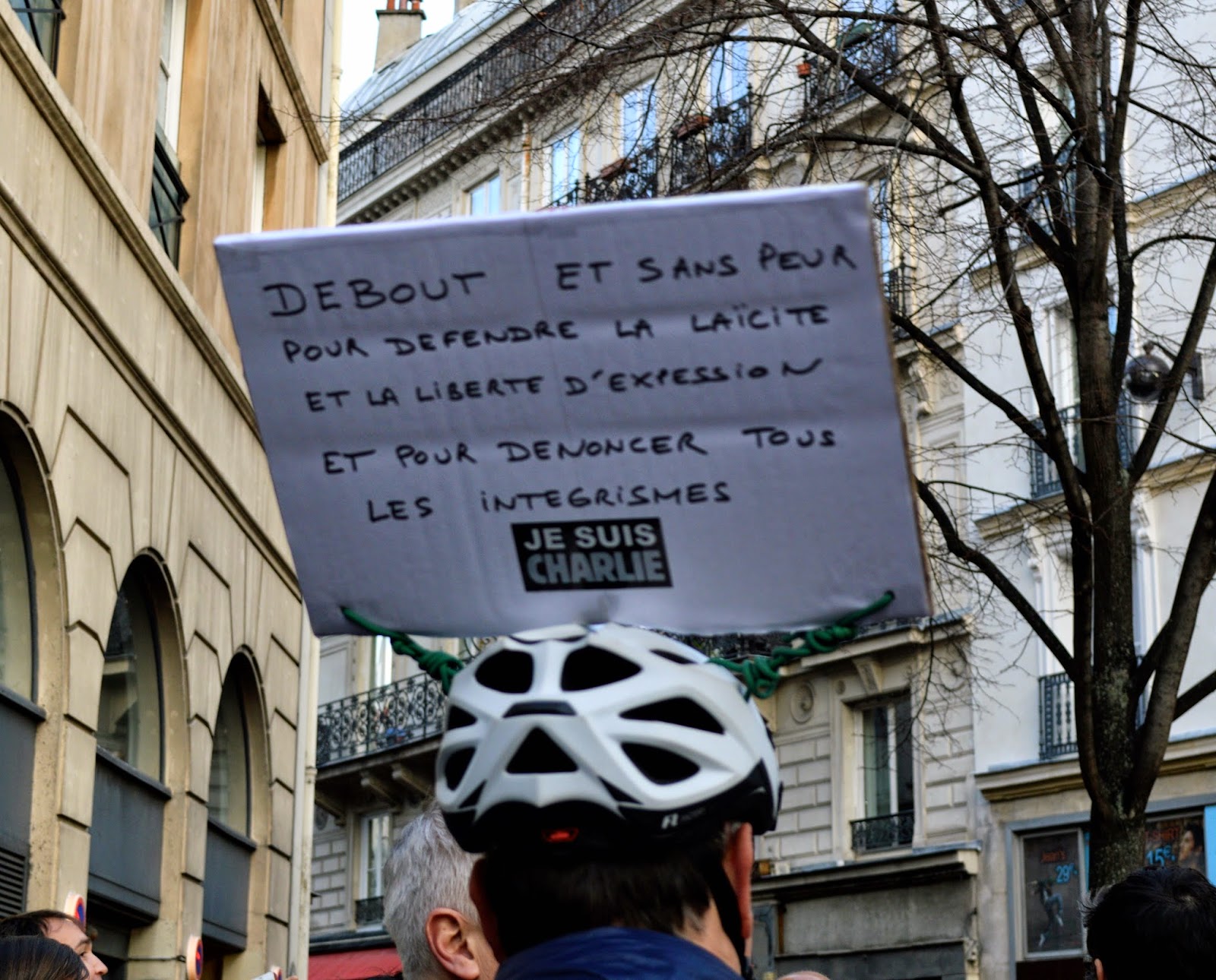
Je suis Charlie


 JE SUIS CHARLIE 
*(French & English)

A l’occasion de la ‘Marche du Siècle’ à Paris, le 11 janvier 2015, qui a vu 1,5 million de personnes à Paris, et quelque 3,7 millions de personnes à travers toute la France, investir les rues au nom de la liberté d'esprit et des principes républicains face aux intégrismes qui chercheraient à nous imposer, à nous faire réendosser des attitudes et des croyances liées à des saisons plus obscures de l’esprit humain.


Il nous était important à Margaret et moi, et il m’était important à moi tout particulièrement en tant que franco-américain par choix, d’être solidaire avec mon pays d'adoption non seulement dans les moments difficiles qu'il vient de vivre, mais aussi dans sa réponse sublime et exaltante à une situation des plus pénibles pour un pays né des idées et des valeurs républicaines.


Arrivés à Paris hier matin, une amie a été extrêmement gentille de venir nous chercher à la gare, ce qui fait qu'on a pu casser la croûte ensemble avant d'aller battre le pavé parisien pour cette belle vision d'une France républicaine à l'instar de celle qui motivait le Marquis de Lafayette à aller encourager la poussée de cette même vision, encore toute hésitante et tremblante, dans une jeune colonie sur l'autre rive de l'océan Atlantique.

On the occasion of the ‘Walk of the Century’ in Paris, the 11th of January 2015, which saw 1.5 million people in Paris, and some 3.7 million people all across the rest of France, take to the streets in the name of free thought and democratic principles, and against the various fundamentalisms that continue to try to impose upon us, to make us put on again, attitudes and beliefs that belong to the more obscure seasons of the human mind.

It was important for Margaret and me, and it was particularly important for me as a Franco-American by choice, to show solidarity with my adopted country, not only in the difficult moments it has just experienced, but also in its sublime and noble response to this most agonizing of all situations for a country born of democratic ideas and values.


When we arrived in Paris yesterday morning, a friend of ours kindly met us at the train station, and we were able to get a bit of lunch together before taking off to pound the Parisian pavement in defense of this lovely vision of a democratic France, a vision reminiscent of the one that motivated the Marquis de Lafayette to leave his home in order to go encourage the growth of this same vision, which was yet trembling and fragile, in the young American colony on the other edge of the Atlantic Ocean.