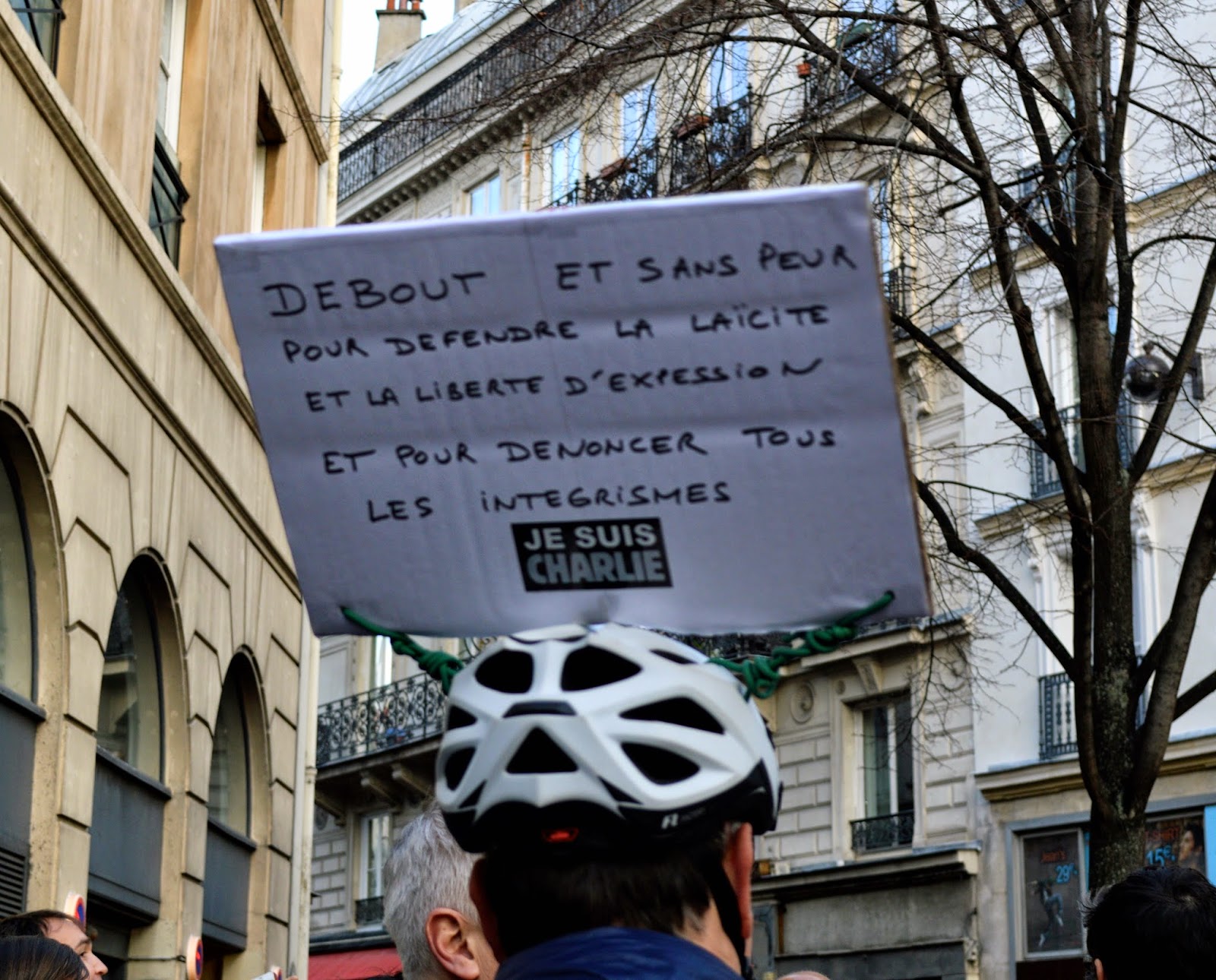
Sunday, February 1, 2015

The Divine Right of Kings


The Old Way
An historical instant is birthed when the great abstraction of space-time collapses onto itself in a single point. It is in such moments as these that opportunities come into being in the world of men, and pass out again, perceived or not, seized upon or not, depending on all the diverse variables and contingencies of human agency, perception, will, intelligence… chance—and that history is made.  Such a ‘moment’ came into being after January 7, 2015 in France, arising out of a great land-swell of individuals coming together as a people around an idea, brandishing the slogan – Je suis Charlie. Now an opportunity is present for all of us to rethink our ‘free’ Western political heritage and thereby, by infirming or affirming old history, to make new history. Now, in this instant, individuals of the west—I and We, standing or not as We the People, stand before a clear possibility to reexamine what types of values we wish to represent through our existence as western Cultures, Peoples, Nations, and States.

The western democratic vision is a surprisingly fragile flower. The English Bard once served up a lovely adage in Romeo and Juliet that "A rose by any other name would smell as sweet," whereby we are made mindful that whether Montague or Capulet, Juliet is still sweet Juliet. To translate by way of transposition, it is no longer so clear that a democracy by any other name…. –because despite sharing the same name, the principles of America democracy are not necessarily the same principles as those that frame the democracy of the Germans, or of the English, or of the French, although American democracy shares perhaps more commonality with French democracy than with other European democracies.
            As a form of governance, the democratic model differs from most other political models in that power of agency is not ‘seated’ in one specific place, as it is in authoritarian or totalitarian models of governance. Instead, it is fragmented into as many pieces as there are participants. Now in order for such a fragmenting model to work, there are certain essential values that must remain intact in order to keep power from coalescing in smaller places, thereby transforming the democratic model into a plutocracy, or autocracy, or oligarchy.
            The model for the democratic vision, of course, is European enlightenment, and flows organically from the beheading of the idea of the divine right of kings. When the one king is dead, then ‘We the People’ is assigned the burden of kingship – each one his own little bit. Upon reflection, though, in the democratic model how does one so tie the power of state to the individual, both philosophically and functionally, that the state is ensured a long, even if complex life? Historically speaking, the model of democracy in the west, inspired by the ideas of enlightenment, began life moored to several fundamental principles: participation in the vote; freedom of expression; separation of religious interference from the function and power of the state; and a press that badgers those holding office in order to inhibit the easy spread of corruption.

On January 7 at about 11:30 Paris local time, heavily armed masked men entered into the offices of a newspaper in Paris and tried to put to death a principle by the assassination of 12 journalists, 12 talking heads, 12 civilian individuals. Certainly the choice of weapons in this war has been set, as well as the tone. Civilian pens and images oppose selective-firing military assault rifles and summary execution; intangible ideas stand up against very tangible ordnance. Unfortunately, though, the very clear imbalance of power between warriors of the pen and militarily armed terrorists, wreaks havoc in the midst of civil society. As one writer has summarized this imbalance of power: 
“Terrorist groups are very difficult to fight for the simple reason that they draw strength from basic “flaws” in Western democracies that are very difficult to address. Among citizens, terrorism provokes a natural reaction: fear coupled with an overwhelming desire for security.”

So the Charlie Hebdo attack in fact revealed a very real ‘weakness’, perhaps even a fatal flaw, in the philosophical framing of the contemporary democratic model.
 
Official Charlie Hebdo
Most of the initial commentaries on the Charlie Hebdo attack focused on the idea of the freedom of expression and freedom of the press; then came those who turned their reflections upon freedom of religion. Unfortunately, and surprisingly, there is not philosophical or legal agreement, no consensus, among western democracies about the precise value of these two principles of freedom. A writer from The Atlantic expresses it well:
“We are all one” was indeed a powerful message, but what did it really mean, underneath the noble sentiment and the liberal faith that all people are essentially good and want the same things, regardless of religion or culture? Even if the scope is limited to Western liberals, the aftermath of the assaults in Paris on Charlie Hebdo and a kosher supermarket has revealed a striking lack of consensus on a whole host of issues, including the limits of free speech, the treatment of religions versus racial groups, and the centrality of secularism to the liberal idea. Turns out, we are not all one.”

FREEDOMS – OF EXPRESSION and RELIGION. There is much rhetoric in the west about Freedom of Speech, and that it is a cornerstone of a free society. Yet one also is quick to discover that this “freedom” is not an absolute concept in most western countries, but that it is circumscribed by any number of definitions, rules, and regulations concerning provocative speech, hate speech, ‘incitement’ speech, respect for religion, etc. Ours is a democratic society in which the phrase, Freedom of Expression or of Speech, is actually a misnomer—there is no such freedom. Rather, there is the Right to Constrained Speech, or speech that is hemmed in on each side by some constraining interest or another – e.g., hatred, race, religion, fill in the blank according to culture, time, and place. Of late, especially since the Charlie Hebdo attack, it seems that much of the conversation about the freedom of constrained speech is linked to religious culture.
            A journalist from New York Magazine expressed the situation in this way: “Every free society, facing the challenge of balancing freedom of expression against other values such as societal cohesion and tolerance, creates its own imperfect solution.”

Possibly the most common myth associated with western style democracy is the notion of secularism, or freedom of religion; and yet even this “freedom,” perhaps especially this freedom, is dangerously absent from western democratic experience. The English philosopher John Locke (1632-1704), who greatly influenced early Americans in their thinking and framing of the best form of governance for a people to adopt, made an excellent case in his 1689 Letter concerning Toleration for the complete separation of church authority from civil authority. To put Locke’s argument succinctly: how can a civil judge make competent distinctions between competing religious authorities with competing claims?  The question is rhetorical, of course, because a civil magistrate cannot intelligently choose between one religious interest and another, not only because any such choice would reek of bias and therefore be subject to criticism as an injustice, but also because a civil magistrate is not formally knowledgeable in how to assess the value or validity of one religious claim over another—how, for example, does a magistrate decide that Methodism is more valid as a religion than Anglicanism? It is therefore more than reasonable, and a reflection of right and just thinking, for Locke to conclude that the separation of church or religious interests from the state or civil interests must be established as an absolute basis for a free democratic society. This is also the normative wiki-definition for secularism, which is “the principle of the separation of government institutions and persons mandated to represent the state from religious institutions and religious dignitaries.”
            Now, this type of freedom may be the theoretical case in the philosophy of democracy, but it is certainly not the de facto case of religious thinking or of the influence of religion in democracy. A writer from The Atlantic, for example, assumes that at least one of the goals of democracy [in France] is religious pluralism – “If the goal is religious pluralism—and in a country with about 5 million Muslims, it should be—then laïcité, by definition, is doomed to fail. It effectively forces observant French Muslims to choose between their religious practice and their French identity.”  The obvious challenge in this line of thinking, however, is that the democratic vision of a John Locke and a Thomas Jefferson, grounded in the absolute separation of private religion from the public sphere, never included the idea of creating a space for private religion. A goal and purpose of the democratic society was never to create pluralism, but only to allow it to breathe and to co-exist, as long as everyone plays by the rules of the democratic environment – thereby ensuring the freedom of expression and religious liberty for all of We the People.
            In the United States the First Amendment to the Constitution bans Congress from passing any law respecting the establishment of religion and from prohibiting people from freely exercising their religion. In 1981 the United Nations General Assembly passed a "Declaration on the Elimination of All Forms of Intolerance and of Discrimination Based on Religion or Belief," which recognizes Freedom of Religion as a fundamental human right. In the Preamble one finds expressed these classic democratic and secular sentiments:
Whereas recognition of the inherent dignity and of the equal and inalienable rights of all members of the human family is the foundation of freedom, justice and peace in the world, Whereas disregard and contempt for human rights have resulted in barbarous acts which have outraged the conscience of mankind, and the advent of a world in which human beings shall enjoy freedom of speech and belief and freedom from fear and want has been proclaimed as the highest aspiration of the common people,

This formulation is not a fluke, because it is expressly reiterated in Article 18 of the same U.N. document: “Everyone has the right to freedom of thought, conscience and religion; this right includes freedom to change his religion or belief, and freedom, either alone or in community with others and in public or private, to manifest his religion or belief in teaching, practice, worship and observance.” And yet, it would seem that this very guarantee is being regularly violated internationally, with impunity, if we are to believe Huffington Post headlines such as, “The Charlie Hebdo Murders: An Attack on Religious Liberty, Not Free Expression” (Doug Bandow; Cato Institute; 1/28/2015).
            So, in the present state of western democracy it is certainly beginning to seem like the civic freedoms of Expression and Religion, which have historically been the philosophical pillars of enlightened democracy, are crumbling under the onslaught of world-wide religious authoritarianism.

BLASPHEMY LAWS & THE QUESTION OF FREEDOM OF EXPRESSION. The diverse western democracies have negotiated diversely the troubled waters that stand between private religion and the public domain. In some democracies the relationship between the private religious and the civic is friendly. In Germany, for example, as in the U.K. and the Netherlands, there seems to be relatively peaceful cohabitation between the church and the state. In other civil societies, however, that relationship is somewhat more tenuous and hostile. Such is the case in France, Mexico, India, Spain, and in the U.S.  In these latter societies, where the separation between church and state is more clearly defined and codified in legislation, where the society is formally ‘open’, one might also expect to see a consistent commitment to secular or non-religious civil social institutions. In societies where the church and the state have a closer co-existence, on the other hand, one might expect to find the growth of stronger and more stable ‘closed’ institutions and structures, by means of which ‘open’ societies remain bound to inherently authoritarian or religious world-views.
            But even the more radical separation of the church from the state in democracy does not guarantee the state’s safety from the inherently colonizing project (proselytism) of religious thinking. The Americans still have the formal theoretical idea of the absolute separation of church and state, and yet their political landscape is infested by the unruly sprouting of Christianized politicians who patiently seek to bring about the velvet coup d’état of transforming civil society into Christian theocracy. Religious America, imitating Moses’ long march through the Sinai, seems to be paving the way for a modern exodus out of state secularism and into a new-world theocracy. But democracy, where political authority has been squarely placed on the shoulders of the individual, is philosophically incompatible with the authoritarianism inherent to a theocratically defined state. At least philosophically, a velvet revolution is indeed afoot in the land of the free and the home of the brave.

Generally speaking, one tends to find blasphemy laws more strongly rooted in those countries that have a close relationship to specific religious traditions. This is predictable in the sense that a blasphemy is, by definition, an insult of or contempt for the sacred; at heart, blasphemy is a religious notion. In countries having a weaker affiliation with formal religion, the notion of the sacred has simply been transferred to the public dimension through the language of hate speech, etc.; but the reality of blasphemy continues to thrive through the various euphemisms of secular thought—this is just a secular expression of the velvet coup d’état designed to move We the People away from the messiness and tension of secularized democracy working itself out through the lives of individuals, and closer to a religious authoritarianism.

In March 2014, in a Policy Brief entitled Prisoners of Belief, The U.S. Commission on International Religious Freedom articulated essentially the same philosophy toward religion, as did John Locke in his 1689 Letter concerning Toleration—which just goes to show how difficult it is to kill a good idea.
“Blasphemy laws inappropriately position governments as arbiters of truth or religious rightness, as they empower officials to enforce particular religious views against individuals, minorities, and dissenters. [… because] In contexts where an authoritarian government supports an established religious creed, blasphemy accusations are frequently used to silence critics or democratic rivals under the guise of enforcing religious piety.”  

The Commission’s brief continues:
“Blasphemy laws are incompatible with international human rights standards, as they protect beliefs over individuals, and they often result in violations of the freedoms of religion and expression, especially when persons are jailed. Article 18 of the International Covenant on Civil and Political Rights (ICCPR) protects the individual right to freedom of thought, conscience and religion, including the right to manifest this belief through various acts, such as worship, observance, practice and teaching. Limitations on this right are narrow, and are only permitted as necessary to protect “public safety, order, health, or morals or the fundamental rights and freedoms of others.” Article 19 of the ICCPR protects the individual right to freedom of expression, which may only be limited to protect the rights or reputations of others, national security, public order, or public health or morals. And in terms of the protection of morals, the UN Human Rights Committee has observed that limitations on this ground “must be based on principles not deriving exclusively from a single [social, philosophical, or religious] tradition.””

The conclusion of this Commission is democratic and secular in the highest degree:
“International law experts have repeatedly deemed blasphemy-type laws incompatible with human rights commitments. For example, the UN Human Rights Committee has stated that “[p]rohibitions of displays of lack of respect for a religion or other belief system, including blasphemy laws, are incompatible with the [ICCPR].” In addition, an international group of experts convened by the Office of the UN High Commissioner for Human Rights recently recommended that “[s]tates that have blasphemy laws should repeal the[m] as such laws have a stifling impact on the enjoyment of freedom of religion or belief and healthy dialogue and debate about religion.” Furthermore, these laws run counter to consensus UN resolutions recognizing that religious intolerance is best fought through positive measures, such as education, outreach, and counter-speech, and that criminalization is only appropriate for incitement to imminent violence.”

A similar philosophy motivates another “independent watchdog organization dedicated to the expansion of freedom around the world,” Freedom House, which argues that, “Founded in 1941, Freedom House was the first American organization to champion the advancement of freedom globally.” On the question of blasphemy laws their conclusion was that:
"blasphemy laws foster an environment of intolerance and impunity, and lead to violations of a broad range of human rights, including the obvious rights to freedom of expression and freedom of religion, as well as freedom from arbitrary arrest and detention; the right to due process and a fair trial; freedom from torture and cruel, inhuman, and degrading treatment; and the right to life and security of the person."”

Among the various players of the democratic game, however, there still remains no especial consensus about the distance, far or near, that is to define religion’s relationship to the civil state. So, if there is still no philosophical agreement about how religion might best coexist within and with the civil state, perhaps it might be possible to find a single unifying concept that could historically bind together the various democracies of the west.

THE DIVINE RIGHT OF KINGS, or RELIGIOUS AUTHORITY and CIVIL SOCIETY. Historically speaking, the birth of the modern democratic principle: We the People, flows from a decline in the idea that kings are innately endowed, from Heaven, with special authority to rule over societies. There are many reasons for the decline in this latter idea, including the perception that kings were not neutral in the distribution of their favors, and that kings could not be held accountable for excesses and corruption. Philosophers, such as Locke, Hobbes, and Rousseau, and other interested parties argued for an alternative view of governance for the civil society, which was grounded in the notion of the ‘consent of the governed’… and, following a series of revolutions and beheadings, the social contract was acclaimed and proclaimed, at the heart of which was very firmly embedded the core idea of We the People.
            This was a moment in western history when it became philosophically clear that authoritarianisms seem just naturally to want to accumulate social and political and financial and religious power among a select few insiders, and that the only practical way to avoid that trap was to fragment and to disperse all social power among the real builders and players of civil society – individuals, who would become in that instant of history ‘We the People’.

Now, even though the various democracies of the world do not necessarily agree on the limitations of speech and religion, it would still seem reasonable that all states which claim their philosophical heritage from the western principle of We the People, should continue to resist the principle of authoritarianism in all of its diverse incarnations; and this must include our resistance to any private Religious Thought trying to impose its values and its worldview in the public space on free hearts and free men.
           
The principle of the divine right of kings is resurrected again in the democratic west only when and where democratic countries allow religious thought, of any ilk, to hold public sway within their borders. And so democracy dies, not with a whimper but with a bang, unless citizenry discovers in itself courage sufficient to stand the ground of its ideas, and commitment enough to the principle of truly free (i.e., unbridled) speech, and to absolute public neutrality on questions of religion. Yet it is unfortunately true, as has been said, that “Among citizens, terrorism provokes a natural reaction: fear coupled with an overwhelming desire for security.”

Who holds the real power of our lives in the democratic state? Philosophers will tell us that we do, as individuals. And yet free speech and free religion in the democratic state, to whatever degree We the People allow it, to whatever degree We the People censure ourselves out of fear, is largely controlled, de facto, by some of the following religious thinkers who have and are attempting to seize control of the free world of ideas, and speech, and religion, and choice, through their fatwas [compiled from various sources and Wikipedia]:
·       L’imam afghan [Mir Faroq Husseini, un dignitaire religieux dans la province occidentale de Herat] qui a offert 400.000 dollars de récompense pour quiconque tuerait le producteur du film islamophobe ainsi que le dessinateur français Charb.
·       Ayatollah Ruhollah Khomeini in 1989 pronounced a death sentence on Salman Rushdie, the author of The Satanic Verses.
·       In 2001, religious authorities in the United Arab Emirates issued a fatwā against the children's game Pokémon, after finding that it encouraged gambling, and was based on the theory of evolution, "a Jewish-Darwinist theory, that conflicts with the truth about humans and with Islamic principles".
·       In 2001, Egypt's Grand Mufti issued a fatwā stating that the show "Who will Win the Million?" (modelled on the British show Who Wants to be a Millionaire?) was un-Islamic. The Sheikh of Cairo's Al-Azhar University later rejected the fatwā, finding that there was no objection to such shows since they spread general knowledge.
·       In Syria, Grand Mufti Ahmad Badruddin Hassoun issued a fatwa prohibiting every type of smoking, including cigarettes and narghile, as well as the selling and buying of tobacco and any affiliation with tobacco distribution (see also Smoking in Syria).
·       Yusuf al-Qaradawi released a fatwā on April 14, 2004, stating that the boycott of American and Israeli products was an obligation for all who are able.
·       Sheik Sadeq Abdallah bin Al-Majed, leader of the Muslim Brotherhood in Sudan, issued a fatwā that prohibits vaccination of children claiming it is a conspiracy of the Jews and Freemasons.
·       Indian Muslim scholars issued a fatwā of death against Taslima Nasreen, an exiled controversial Bangladeshi writer. Majidulla Khan Farhad of Hyderabad-based Majlis Bachao Tehriq issued the fatwā at the Tipu Sultan mosque in Kolkata after Juma prayers as saying Taslima has defamed Islam and announced an “unlimited financial reward” to anybody who would kill her.
·       In 1998, Grand Ayatollah Sistani of Iraq, issued a fatwā prohibiting University of Virginia professor Abdulaziz Sachedina from ever again teaching Islam due in part to Sachedina's writings encouraging acceptance of religious pluralism in the Muslim world.
·       In June 1992, Egyptian writer Farag Foda was assassinated following a fatwa issued by ulamas from Al-Azhar who had adopted a previous fatwa by Sheikh al-Azhar, Jadd al-Haqq, accusing secularist writers such as Foda of being "enemies of Islam". The jihadist group Al-Gama'a al-Islamiyya claimed responsibility for the murder.
·       In 1951 Egypt issued a fatwa on Coca-Cola and Pepsi-Cola citing it was safe for Muslims to drink both beverages since "they do not contain narcotic or alcoholic substances, nor do these analyses show the presence of pepsin. From the bacteriological point of view the beverages are free of microbes harmful to health."
·       Osama bin Laden issued two fatwās—in 1996 and then again in 1998—that Muslims should kill civilians and military personnel from the United States and allied countries until they withdraw support for Israel and withdraw military forces from Islamic countries.
·       Earlier this month a video was release showing another AQAP [Al-Qaeda in the Arabian Peninsula] leader, Nasser bin Ali al-Ansi, claiming responsibility for the attack on French satirical magazine Charlie Hebdo, which claimed 12 lives. According to reports from RFI (Radio France Internationale), "We, Al-Qaeda in the Arabian Peninsula, claim responsibility for this operation as vengeance for the messenger of Allah," one of the group's leaders, Nasser al-Ansi, said in reference to the magazine's publications of caricatures of the Prophet Mohammed.”

In memoriam, not just to these executed individuals from Charlie Hebdo, who are only the most recent victims to the divine right of kings, but also to the very idea of secular democracy—unless the west continues to ensure that the voices of divinely inspired “kings” are given no hearing in civil society.

[#CharlieHebdo : la vidéo hommage de France Télévisions ; #NousSommesCharlie]

Further reading: Profane. Sacrilegious Expression in a Multicultural Age, edited by Grenda, Beneke, and Nash. University of California Press, 2014.

Monday, January 12, 2015

Je suis Charlie


 JE SUIS CHARLIE 
*(French & English)

A l’occasion de la ‘Marche du Siècle’ à Paris, le 11 janvier 2015, qui a vu 1,5 million de personnes à Paris, et quelque 3,7 millions de personnes à travers toute la France, investir les rues au nom de la liberté d'esprit et des principes républicains face aux intégrismes qui chercheraient à nous imposer, à nous faire réendosser des attitudes et des croyances liées à des saisons plus obscures de l’esprit humain.


Il nous était important à Margaret et moi, et il m’était important à moi tout particulièrement en tant que franco-américain par choix, d’être solidaire avec mon pays d'adoption non seulement dans les moments difficiles qu'il vient de vivre, mais aussi dans sa réponse sublime et exaltante à une situation des plus pénibles pour un pays né des idées et des valeurs républicaines.


Arrivés à Paris hier matin, une amie a été extrêmement gentille de venir nous chercher à la gare, ce qui fait qu'on a pu casser la croûte ensemble avant d'aller battre le pavé parisien pour cette belle vision d'une France républicaine à l'instar de celle qui motivait le Marquis de Lafayette à aller encourager la poussée de cette même vision, encore toute hésitante et tremblante, dans une jeune colonie sur l'autre rive de l'océan Atlantique.

On the occasion of the ‘Walk of the Century’ in Paris, the 11th of January 2015, which saw 1.5 million people in Paris, and some 3.7 million people all across the rest of France, take to the streets in the name of free thought and democratic principles, and against the various fundamentalisms that continue to try to impose upon us, to make us put on again, attitudes and beliefs that belong to the more obscure seasons of the human mind.

It was important for Margaret and me, and it was particularly important for me as a Franco-American by choice, to show solidarity with my adopted country, not only in the difficult moments it has just experienced, but also in its sublime and noble response to this most agonizing of all situations for a country born of democratic ideas and values.


When we arrived in Paris yesterday morning, a friend of ours kindly met us at the train station, and we were able to get a bit of lunch together before taking off to pound the Parisian pavement in defense of this lovely vision of a democratic France, a vision reminiscent of the one that motivated the Marquis de Lafayette to leave his home in order to go encourage the growth of this same vision, which was yet trembling and fragile, in the young American colony on the other edge of the Atlantic Ocean.

Monday, December 1, 2014

December & January’s Essay_The Superman & The Eternal Return_The Great Unlearning II


Much has been written, much thought, and much else believed about Nietzsche’s notion of the Übermensch, culminating in what is perhaps the notion’s most inappropriate, because malapropic contemporary translation: ‘It’s a bird…It’s a plane… It’s Superman.’ In this contemporary adaptation it just seems so irresistibly easy to imagine Superman arriving on the scene of some human drama and pronouncing in the mellifluous intonations of the very-French, love-crazed skunk of cartoondom, Pépé le Pew: “I am ze Übermensch.”
Ubermensch, from Nerfnow.com
            In order to talk about Nietzsche’s notion of the Übermensch, we must first needs restore Seneca’s aphorism to “quae philosophia fuit facta philologia est” (“What was philosophy is now become philology”), which, in his 1869 inauguration address on ‘Homer and Classical Philology’ at the University of Basel, the new professor of philology inverted to mean, “What was philology is now become philosophy.” Because it would seem that mainstream opinions about Nietzsche’s Übermensch are more concerned with the possible meanings of the word, Übermensch, than in the philosophico-psychological concept the word is intended to hold up.
            The Übermensch idea remains elusive at least in part due to the prepositional prefix –über (over, beyond, and super (if dragged kicking and screaming through a layer of Latin)) attached to the word –mensch (person), and it has been translated into English diversely—as ‘Beyond-Man’, ‘Superman’, and ‘Overman’. None of these are particularly happy translations, however, because they remain burdened by the compulsion for a one-word for one-word literalism that sometimes, actually many times, just does not work between languages.
           
§ THE ZEITGEIST OF THE 19TH CENTURY

Nietzsche’s Übermensch is conceived in an 18th-19th century thought-world [Gedankenwelt] defined by the two influences of Hebraism, which is to say the Judeo-Christian religious heritage of western civilization, and Hellenism, or the vigorous resurgence of Greek cultural ideas through Anglo-German poetry and scholarship.
            Matthew Arnold published Culture and Anarchy (1869) in the UK to mixed or mostly negative reviews. And yet the framing of that book not only anticipates, but resembles comme deux gouttes d’eau the framing of Nietzsche’s own thinking: the same motifs familiar to readers of Matthew Arnold will inform Nietzsche’s thinking, from the works of his youth, such as Die Kindheit der Völker (1861), which Nietzsche composed as a 15-year old student, through his first scholarly book, The Birth of Tragedy (1872), and the Genealogy of Morality (1887), which goes to show that the “framing” of his ideas will remain significant to Nietzsche throughout his thinking and writing life.
            The title of perhaps the most famous chapter in Arnold’s Culture and Anarchy is “Hebraism and Hellenism,” which suggests a certain opposition of ideas. In a review published recently in The Weekly Standard, a noted American historian calls this antithesis unambiguous:
The governing idea of Hellenism is spontaneity of consciousness; that of Hebraism, strictness of conscience. The uppermost idea with Hellenism is to see things as they really are; the uppermost idea with Hebraism is conduct and obedience. The Greek quarrel with the body and its desires is that they hinder right thinking; the Hebrew quarrel with them is that they hinder right acting. Hellenism is comfortable in the “pursuit or attainment of perfection”; Hebraism, obsessed with sin, sees only “the difficulties which oppose themselves” to perfection.

Both Arnold and Nietzsche are ‘prophets of culture’ who are working within very similar zeitgeistige framings. Yet Arnold and Nietzsche draw strikingly dissimilar conclusions from their thinking. For Arnold, “The two [principles of Hebraism and Hellenism] are not so much opposed, … as “divergent,” animated by “different principles” but having the “same goal” and “aiming at a like final result.” Both are “contributions to human development—august contributions, invaluable contributions.” Both “arise out of the wants of human nature, and address themselves to satisfying those wants.”
            For Nietzsche, on the other hand, as the Genealogy of Morality makes unambiguously clear, the creation of ‘Morality’ is an anti-life evolution of thought, a nihilism that kills the naturally ‘Good’ wherever it comes into existence. For Arnold, it is truly “Hebraism and Hellenism,” whereas for Nietzsche it is “Hebraism vs. Hellenism.” So there are many similarities clearly showing that Matthew Arnold and Friedrich Nietzsche come from the same thought-world, which suggests a more general philosophical arena for these framings and these thoughts. However, there is absolutely no traceable, direct contact between these two thinkers. Nietzsche does not seem to know about Matthew Arnold, nor are there any of Arnold’s writings in Nietzsche’s personal library.

§ UNDERMEN AS OVERMEN – A “HISTORY” OF FALSE STARTS

Nietzsche as Superman, from Metal Gear
Famous, but alas all too typical of the Übermensch idea in normal parlance, is the “Leopold and Loeb” case in Chicago of the 1920s. In the Wiki-telling: L&L are two students who, becoming friends at the University of Chicago and having a shared interest in committing the ‘perfect crime’, dusted off their portable Nietzsche and convinced themselves that they were Übermensch “— transcendent individuals, possessing extraordinary and unusual capabilities, whose superior intellects allowed them to rise above the laws and rules that bound the unimportant, average populace. …[B]y [Leopold’s] interpretation of Nietzsche's doctrines, he was not bound by any of society's normal ethics or rules. Before long he had convinced Loeb that he, too, was an Übermensch. In a letter to Loeb, Leopold wrote, "A superman ... is, on account of certain superior qualities inherent in him, exempted from the ordinary laws which govern men. He is not liable for anything he may do."
            L&L did not succeed in committing the perfect crime; so Clarence Darrow, of Scopes Monkey Trial fame (1925) and otherwise champion of scientifically minded rationalism, was engaged to defend the two men. In the defense of his two clients Darrow succeeded in accomplishing two things. First, it would seem that he probably saved Leopold and Loeb from being executed by the state of Illinois for their murder of Robert Franks, because both were only sentenced to life imprisonment, which seemed to buck the trend at the time. Second, Darrow succeeded in transforming Nietzsche and his notion of the Übermensch into the stooge for human arrogance, a sense of social entitlement and superiority, and evil intent. In Darrow’s version of the facts-and-only-the-facts, L&L were just two normal lads who turned bad because they had had the misfortune of too much philosophy, of reading too much Nietzsche in their youth. It remains undecided whether philosophy in America has ever really shaken this guilt by association.

Some, such as a writer for Philosophy Now, see some kind of connection between Nietzsche’s Übermensch and the Over-soul of Ralph Waldo Emerson, the American transcendentalist, who published “The Over-soul” as Essay IX in his Essays: First Series in 1841. In PN’s article, entitled “Nietzsche’s Übermensch: A Hero of Our Time?,” we read that
The term Übermensch, often translated as Superman or Overman, was not invented by Nietzsche. The concept of hyperanthropos can be found in the ancient writings of Lucian. In German, the word had already been used by Müller, Herder, Novalis, Heine, and most importantly by Goethe in relation to Faust (in Faust, Part I, line 490). In America Ralph Waldo Emerson wrote of the Oversoul, and, perhaps with the exception of Goethe’s Faust, his aristocratic, self-reliant ‘Beyond-man’ was probably the greatest contributor to Nietzsche’s idea of the Übermensch.

It is indisputable that Emerson greatly impressed Nietzsche, an interest and an affinity that spanned Nietzsche’s entire life. Unfortunately, while there does seem to be a demonstrable connection between Carlyle, Goethe, Emerson, and Nietzsche on the notion of the Great Man, that connection does not in any way contribute to or inform our interpretation of Nietzsche’s Übermensch.
            The PN author also draws upon a Fordham University article, Nietzsche’s Zarathustra and Parodic Style: On Lucian’s Hyperanthropos and Nietzsche’s Übermensch, to establish some kind of philologists’ “must-have-been” connection between Nietzsche’s Übermensch and the Greek term coined by the 2nd century AD satirist, Lucian of Samosata. Unfortunately, while it is certainly accurate to say that the term hyper-anthropos is found in the writings of Lucian, it is equally accurate to say that any reference to Lucian in Nietzsche’s corpus is entirely tangential, as opposed to substantial, and that hyperanthropos never occurs in his work.
            Furthermore, the hapax usage of hyperanthropos in Lucian (in The Downward Journey, sec. 16; Loeb, vol. 2, 1999) is employed by a neighbor of the tyrant Megapenthes, whose name is Micyllus, and who says that the tyrant,
appeared to me a super-man, thrice-blessed, better looking and a full royal  cubit taller than almost anyone else ; for he  was uplifted by his good fortune, walked with a  majestic gait, carried his head high and dazzled all he met. But when he was dead, not only did he cut an utterly ridiculous figure in my eyes on being stripped of his pomp, but I laughed at myself even more than at him because I had marveled at such a worthless creature, inferring his happiness from the savour of his kitchen and counting him lucky because of his purple derived from the blood of mussels in  the Laconian Sea. 

As a satiric description attached to the somewhat ludicrous, I-wish-I-weren’t-dead tyrant Megapenthes, who is attempting to negotiate his way out of Hades, this irony-laden connection seems an obscurantist and erudite non-starter as far as the history of Nietzsche’s idea might be concerned.

Other ‘literature’ on the question of the Übermensch is polyphonic and both predictably and unhelpfully inconclusive, although the populist consensus seems determined to associate the concept with eugenics and the creation of a higher biological type. Some, such as Safranski (Nietzsche: A Philosophical Biography, p. 365), arguing a variation on the biologism theme, think that, “Nietzsche intended the ultra-aristocratic figure of the Übermensch to serve as a Machiavellian bogeyman of the modern Western middle class and its pseudo-Christian egalitarian value system.” This interpretative trend was certainly also evident in Nazi thought, which used Nietzsche’s concept of the Übermensch to articulate a particular national version of the Aryan master race.
            Popular culture, as well, has certainly had a wonderful time fussing with Übermensch-type characters, from Siegel’s first villainesque Superman, to G.B. Shaw, and James Joyce. In more philosophically interesting treatments, of course, there are always Ayn Rand’s transmogrifications of the Übermensch into her radically individualistic and supra-moral Supra-Men. Likewise, in George Bernard Shaw’s Man and Superman, a four-act drama written in 1903, there is the famous act called Don Juan in Hell (Act 3, Scene 2), which is often produced as a stand-alone piece. It consists of a dream-act debate concerning the advantages of Hell, which, in quintessentially übermenschlicher style reminiscent of Faust’s Mephistopheles, include art and beauty and love and pleasure, whereas Heaven will only celebrate rational discourse and the dissemination of the Life Force. The Devil defends such hedonistic amenities, whereas Juan wants none of them and heads for a thinker's Heaven. There is a theater review here, and a YouTube version of Don Juan in Hell here.

§ I THOUGHT I SAW AN ÜBERMENSCH… I DID, I DID.

Tweety & Sylverster
There is every sort and variety of opinion ‘out there’ about the Übermensch; and they occupy whatever thought-terrain is fertile enough to sustain them. However, all the above opinions about Nietzsche’s Übermensch are simply wrong and wrong-headed—they have nothing to do with Nietzsche’s thinking. So who is, or can be, an Übermensch? Who exactly are ‘those who have gone beyond’? And, if this is indeed a philosophical model of some sort, or a political model, or a heroic model, what is the exact profile?

There are some Nietzsche scholars who are actually subtle enough in their thinking to understand that Übermensch is not a state of ontology, but rather a state of mind. Nietzsche is not proposing an Antichrist, or a Führer, or a Carlylean Great Man; rather, he is proposing to his readers something much more akin to a philosophico-psychological adjustment such as taught by Epictetus in the Enchiridion: e.g., “Of things that can happen to us in a lifetime, there are some that we can control [are dependent upon us], and some that we cannot control [are not dependent upon us].” Corrections of this type in our thinking, says Nietzsche, will transform us into freie Denker, free thinkers, and ultimately, free minds.
            There is evidence that some contemporary scholars are reading Nietzsche psychologically, such as in the essay entitled ‘Nietzsche and the Greeks’ published recently (2013) in the The Oxford Handbook of Nietzsche. There we read that, “Nietzsche was generally more interested in the psychological consequences of philosophical doctrines than in their content.” There is also a 2010 book, Nietzsche, Psychology, and First Philosophy, which challenges “various traditional views of Nietzsche, taking him at his word when he says that his writing can best be understood as a kind of psychology.”
            It might be helpful to recall our intellectual history—that psychology as a discipline is only a very young blossom on the western vine of knowledge, and only began separating itself from philosophy after the 1850s. So it would seem reasonable, given the time frame, that Nietzsche should in fact consider himself a psychologist; and in fact, the self-identification as psychologist permeates Nietzsche’s writing, and especially the Twilight of the Idols [1888]:
·      Beyond Good and Evil [1886: 76, 20]: “Der neue Psycholog bereitet dem Aberglauben ein Ende, der bisher um die Seelen-Vorstellung wuchterte.”
·      Twilight of the Idols [77, 343]: “Aus meinen Schriften redet ein Psychologe.”
·      Twilight of the Idols [77, 405]: “Es gab vor mir noch gar keine Psychologie.”

Finally, among his aphorisms from Idols is number 35: “Es giebt Fälle, wo wir wie Pferde sind, wir Psychologen, und in Unruhe gerathen: wir sehen unsren eignen Schatten vor uns auf und niederschwanken. Der Psychologe muss von sich absehn, um überhaupt zu sehn.”

Nietzsche the psychologist, then, reminds us that it is the wrong question to ask for models of what the Übermensch can be… It is not about some particular model of a more-than-human, but rather the mental context of an übermenschlich state of mind.
            As a psychological moment, the Übermensch-realization is actually a fusion of two distinct insight-events. Aristotle, in his Poetics [1452a&b], refers to the first insight-event as a discovery [anagnorisis], as the recognition of the moment of “seeing” something, of grasping the truth about something, of the ah-ha moment when we ‘get it’. It is that very private moment in the life of our mind when, finally, the light bulb goes on and we realize that… for example, our partner does not love us, or that someone has been cheating on us, or that our boss has been defrauding the company, or, or, or…
            Obviously, there are untold examples of this insight-event in literature, but it is important for Nietzsche that these moments should be psychologically correct, that they should correspond to the actually lived human condition of mind, and that they should take us beyond ourselves into a different sphere of knowing.

Aristotle himself thinks that Sophocles’ depiction of this moment in the life of Oedipus is superb—the moment when Oedipus, cast down under the weight of his misery and shame, stabs out his eyes, finally realizing that blind, he would see no worse than with his eyes wide open.
            There are also other great and moving insight-events in literature, such as when Ajax falls upon his sword after finally realizing that Athena has deceived him and blinded him through folly; or when Viktor Frankenstein realizes that the creature he has made is no man, but a monster; or when Milton’s Satan [Book 9; lns. 458-466], standing before Eve and contemplating even then the enormity of the evil he was going to bring into her life in Paradise, is struck dumb before her loveliness.
                                    Her heavenly form
Angelic, but more soft, and feminine,
Her graceful innocence, her every air
Of gesture, or least action, overawed
His malice, and with rapine sweet bereaved
His fierceness of the fierce intent it brought:
That space the Evil-one abstracted stood
From his own evil, and for the time remained
Stupidly good; of enmity disarmed,
Of guile, of hate, of envy, of revenge:

However humanly touching these illustrations may be, none of these particular insight-events actually captures what Nietzsche intends with his Übermensch-realization, which is an insight-event actually quite limited in scope. In addition to the insight-event as a psychological event, Nietzsche’s Übermensch-realization is also about a very specific type of realization. It is about the insight that dawns on us when we finally grasp that Everything we have “believed” about Value, about morality and moral thinking, about right and wrong and good and evil, and about human destiny, is philosophical misdirection.  It is a layer of fiction applied to a world of fact—an unhappy because antagonistic joining if ever there was.
            Through his Zarathustra, Nietzsche has undertaken the task of radically rethinking the foundations of morality, and of imagining the psychological and emotional consequences of that rethinking in the normal course of a life. Just imagine the psychic wreckage and emotional damage! Just imagine the courage needed, the daring, to overcome; and the innocence and willingness to throw ourselves, body and soul, into a life that is to be newly created and defined each and every day, entirely by us.
            Nietzsche’s Zarathustra is the story of such a mental and emotional journey, which has three quite distinct segments. As the journey begins, (and we have to remember that this is a journey possible to each one of us through the imagination), Zarathustra has to imagine first that he is a camel. The camel is the perfect Beast of Burden; it is an animal that carries, almost as if by second nature, burdens that are not his own. The first leg of Zarathustra’s journey, then, is to become aware that he also, like the camel, carries a burden that is not properly his own—the burden of ideas and values and beliefs that are inherited through the mother milk, which grow up inside us as we grow up, almost as a second skeleton, which becomes so fundamental to our psyche that it organizes all the spaces of our minds into our own private character.
            The lion characterizes the second segment of Zarathustra’s journey of the mind. This segment of the journey, which demands all the courage of the lion, happens only in the solitary wastelands of the mind, where we give battle to the fiction of inherited morality, where we finally push it away from our minds and dare to stand alone in human history, finally.
            The child embodies the third and final segment of Zarathustra’s journey of the imagination. What happens to us, emotionally, when we finally dare to step out of an abusive or horrible situation? There is a sense of relief, certainly; but there is also a sense of being overwhelmed because we have to start all over again. So, says Nietzsche, we have to put on the mind of the child – to accept in all innocence the new-Beginning of the world that stands before us; and we have to go on to create anew our life, not just physically, but also and especially psychically.

Thus spoke Zarathustra.

§ ETERNALLY RETURNING – WINDMILLS IN YOUR MIND.

Psychological Time
According to Nietzsche, a fundamental element of the Übermensch life of the mind is the recognition of the Eternal Return of the Same, or Eternal Recurrence. As an idea, this certainly brings back to mind the Noel Harrison tube, “The Windmills of Your Mind,” that was such a smash in the late 1960s.
Round like a circle in a spiral, like a wheel within a wheel
Never ending or beginning on an ever spinning reel
[…]
Like a clock whose hands are sweeping past the minutes of its face
And the world is like an apple whirling silently in space
Like the circles that you find in the windmills of your mind!


Nietzsche’s thinking about the Übermensch is framed in the zeitgeist of his century, which tended to separate time into sacred or divine history [e.g., Hebraism; Heilsgeschichte] and human empirical time [Hellenism; Geschichte]. This is a distinction that will also be much and usefully exploited by the philosopher and historian of religion, Mircea Eliade.
            First in Nietzsche’s thinking about the eternal return, is the idea that divine or Christian history is a linear conception. This is to say that we humans enter into the sacred flowing at some point, and the current takes us unidirectionally toward the culmination of time in the Parousia of God. This linear notion of history, or divine history, reasons Nietzsche, usurped at some remote time the Greek or natural pagan notion of history, which saw time as a series of recurring revolutions or cycles in the ‘great clock of being’ (Zarathustra). For Nietzsche, the Übermensch stands before a choice—to live out his life through unidirectional divine time, which is the destruction of fully human time and, thus, a nihilism, or to cast himself into the multi-faceted organization of the world’s, and so into man’s, natural time: “…it is the world which redeems our contingent existence, reintegrating the Christian ego into the order of cosmic necessity, i.e., into the eternal recurrence of the same” [Gay Savoir § 341-342, under “the heaviest burden” and “the death of God” § 343]. Clifford Geertz, the American anthropologist, will translate this idea into the following: ‘One of the most significant facts about us may finally be that we all begin with the natural equipment to live a thousand kinds of life but end in the end having lived one.’
            Natural cyclical time, where we enter and re-enter into the full stream of a fully human experience and creation of time, is an ancient concept found not only in the philosophies of India and Egypt, but also in Greek antiquity, and notably among the Stoics and Pythagoreans. Nietzsche encapsulates this idea in a very Epictetan or Stoic value: Amor fati, a Latin expression about ‘embracing one’s fate’ because it is one’s own. In his book Meaning in History, Karl Löwith reminds us on this point (p. 216) that Nietzsche introduces this idea, “not as a metaphysical doctrine but as an ethical imperative: to live as if “the eternal hourglass of existence” will continually be turned, in order to impress on each of our actions the weight of an inescapable responsibility.”
            Among the Greeks the notion of Eternal Recurrence was normative, and included living a life “in harmony with nature” (Plato’s Philebus); the idea of circularity (of lives, the process of generation and creation, orbit of planets, etc.) – Heraclitus, Empedocles, Pythagoras, Plato (cf. esp. Timaeus, The Statesman, and The Republic), Aristotle, Eudemos of Rhodes, the Stoics, and the Hellenistic astronomer Hipparchus, who will contribute the idea of the equinox precession (the slow spin of the earth) to Plato’s Great Year, which idea will recur later in Cicero’s De Natura Deorum.
Like a circle in a spiral, like a wheel within a wheel
Never ending or beginning on an ever spinning reel
As the images unwind, like the circles that you find in
The windmills of your mind!