~by David Aiken~
9 November 2016 / No. 1268, p. 12.
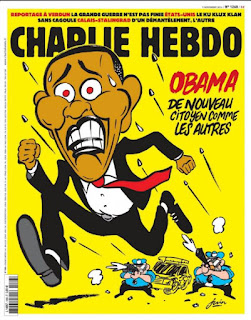
Under the rubric: Charlie sitting by the fire.
Icons. “Arendt-Heidegger: The Fall of the Idols.” By Yann Diener
“ABSTRACT: The passion that tied Hannah Arendt to Martin Heidegger was not just of the flesh. Despite the apparent contradictions, and despite the awkwardness that resulted from it, we are obliged to conclude that this passion represented as well an intellectual bond. Emmanuel Faye’s recent book provides a new look at the complex relationship between these two icons of 20th century philosophy.
In his recent work, Arendt and Heidegger, Nazi Extermination and Destruction of Thought (2016: Albin Michel), the philosopher Emmanuel Faye shows that Hannah Arendt, who has been considered the critic of totalitarianism, adhered for the most part to the ideas of Heidegger. After publishing in 2005 Heidegger, the Introduction of Nazism into the Philosophy, Emmanuel Faye is now interested in the relationship between Heidegger and Arendt, and in particular the role of philosophy in the world-wide diffusion of the texts of her former professor.
The work of Arendt has become compulsory in any analysis of totalitarianisms, and yet her work embodies an apologetic for Heidegger. An anti-Semitic Heidegger, who eulogizes the “internal truth and grandeur” of the Nazi movement. Is this a contradiction? Up to now, everyone has preferred explaining this ambiguity by citing the relationship between Arendt and Heidegger (the professor and the student were lovers in the 1920s). Everyone wanted to believe that Arendt was protecting her love for Heidegger without following him in his ideas. Unfortunately, this is unconvincing.
After rereading the texts of Arendt, which referred either explicitly or implicitly to Heidegger, and after accessing an unpublished correspondence, Faye shows that the attachment of Arendt for Heidegger is profound. She chose to adopt the ideas of her former professor, to “follow in his footsteps,” – to use her expression. The idea of Nazism that Arendt has, which is functionalist and structural, allows her to rehabilitate all of the Nazi ideologues: she sees Nazism and its crimes as the extreme consequences of the way our mass societies function. We all knew already that Arendt was shocking when she put forward the thesis that the Jewish Councils shared in the responsibility for the extermination. Faye underlines that she goes so far as to assert their co-responsibility with the Nazis, and to reduce the Final Solution to resolving an overpopulation problem.
In fact, both The Origins of Totalitarianism and The Human Condition, two Arendt texts that constitute the foundation for much current scholarship about totalitarianism, develop a vision of modernity that is entirely Heideggerian in nature. Of course, Arendt is not Heidegger; and Faye certainly knows that Arendt did not have access to the Black Notebooks or to Heidegger’s more violent texts, those which have only now been added to the corpus of the Complete Works.
God of Thought.
But Faye also shows the effort made by Arendt to raise Heidegger up to the level of being a ‘God of Thought’, by contrasting him with Eichmann, the ‘One Who Does Not Think’. With this nightmare couple, Arendt creates what Faye calls a bipolar structure, a sort of new Modern Myth. We understand better why Arendt accepted the thesis of Eichmann at the time of his trial, and why she constructed the conceit of this banal fool, a cold executioner without ideas – although we have since learned that there was also an Eichmann, Ideological Fanatic.
Faye’s minutious demonstration is very disconcerting, but also very important for at least two reasons. For constructing a more complex analysis of totalitarian ideas and projects, both past and present, religious or not. And, for allowing Faye to interrogate other 20th century authors who claim to derive from Heidegger, like Sartre, Levinas, or Derrida (when Derrida critiques Heidegger, he uses Heidegger’s ideas!). And then there is Lacan. At the beginning of his teaching career Lacan depended enormously on Heidegger. Even if Lacan was able to get past Heidegger, the disciples of Lacan – and myself first of all – depend all too much and too lightly on a Lacan who cites Heidegger. The debate, even if it is violent, has been happening on the battlefield of philosophy, but it has not yet happened on the psychoanalytical battlefield.
It is one of the merits of Emmanuel Faye’s book, that it encourages us to shake up our idols. So, philosophers and psychoanalysts, just another little effort to stop being Heideggerian.”
23 November 2016 / No. 1270, p. 12.
Under the rubric: Charlie sitting by the fire.
Intellectual Bankruptcy. “Finished, pop-philosophy, here comes Trump-philosophy.” By Yann Diener
“ABSTRACT: More than any other electoral campaign, the campaign that pits Trump against Clinton happened without any debate about ideas. Nothing surprising, then, that Slavoj Zizek should put in his two-cents worth, the philosopher-guru who offers as his basic argument that we should keep fleeing into the future.
Whoever said that Trump did not have any intellectuals with him? He may have had only one supporter from the university-world, but that came from someone who has the ear of a great many American and European students: Slavoj Zizek, the Slovenian philosopher, who has been hosted by all the important American universities, and has become the star of pop-philosophy. This is a notion invented by Gilles Deleuze, and which consists of applying philosophical questions to trivial objects, a strategy that Zizek has pushed to the nth degree, to the point that he has even been called the Elvis of social criticism.
Students from Berkeley or from New York University were astonished to hear this famous thinker come out in favor of Donald Trump’s candidacy. They were baffled to hear Zizek describe the millionaire as a disgusting but necessary revolutionary, during an interview on British Channel 4, last November 3rd.
Zizek said in this interview that, were he an American, he would vote for Trump; then he engaged in a number of dialectical pirouettes for which he is famous. Certainly, Trump scares Zizek; but the real danger, he says, is Clinton. “Where I was entirely in agreement with Trump: When Bernie Sanders finally threw his support to Hillary, Trump announced that it was as if someone from Occupy Wall Street was backing the Lehman Brothers.”
Zizek finished the interview by saying that he was delighted by the businessman, “who stomped on all the non-written rules that make politics possible, and upon which everyone agrees: Trump threw a monkey-wrench into all that.”
Apologies for the fine Hegelian dialectic, but this demonstration seems to me to be just as short-sighted as the one from the worker in the Nord-Pas-de-Calais region who votes Front National (Marine Le Pen’s extreme right wing party) because we have not yet tried Le Pen in a position of power, and because such a vote would certainly not fail to stir things up in the present system.
Again, Slavoj Zizek: “If Trump wins, the two biggest parties, republicans and democrats, will have to return to their bases, will have to rethink themselves, and then perhaps something can happen. This is my hope, my desperate hope. Trump will not introduce fascism, because America is not yet a dictatorship. But it will be a sort of big wake-up call. New political processes will be put into place. Even if I am aware that it is dangerous, and not just in terms of supremacist groups: Trump has said openly that he will name extreme rightwing people to the Supreme Court. There are dangers, but I am more afraid that Hillary will stay aligned with this total inertia, which is even more dangerous.” (Note that Zizek uses Trump’s name, but addresses Clinton by her first name.)
The End Justifies the Means.
The great Slovenian philosopher turned political scientist and seer: he assures us that fascism is not for tomorrow in the United States. Does he regret this? After all, he did claim that Hitler had not been “violent enough” [TN: in “Why Heidegger made the right step in 1933,” International Journal of Zizek Studies, I, 4, 2007]. (That must have been more of that dialectic…).
Zizek calling for a Trump vote, is a little like Derrida declaring in 2002 that the election of Le Pen would cause a great wake-up call for the political parties. Is it possible that Zizek, who is often thought of as a useful provocateur, bubbling over with neat, subversive ideas (such as, recently, that of remilitarizing Europe), might even be a bit of an embarrassment to the extreme left with this pronouncement? This Left that sees in him, along with his friend Badiou, their Great Thinker.
Roland Barthes used to say that in order “to exasperate the fixed order of sentences, to break the structures of language,” one does not need subversion. You have to have an upheaval. Barthes himself did not used to predict from which horizon the earthquake would come. So we are forced to observe that for Zizek, as for Badiou, the end justifies the means: Pol Pot, or the jihad, or, today, Trump, are the disruptions necessary to overthrowing the system in place.
Which puts Zizek on the same page as the neocon Newt Gingrich, principal actor in the “conservative revolution” of the 1990s and probable Secretary of State in the future American administration. On the eve of the beginning of the American primaries, Gingrich announced that the candidacy of Trump constituted “one of those vital disruptions whose nature it is to remodel everything.”
And now that Trump has been elected, what does our philosophical Elvis say? He continues to strike out at Clinton, and does not criticize anything but the physical appearance of the president elect: he even writes a column in Le Monde of November 12th entirely dedicated to Trump’s hair style!
Zizek has passed, resolutely, from pop-philosophy to Trump-philosophy. In recompense, he is still waiting for his appointment to the deanship of some important American university, in order to be able to set into motion the great awakening of University Thinking.”
28 December 2016 / No. 1275, p. 3.
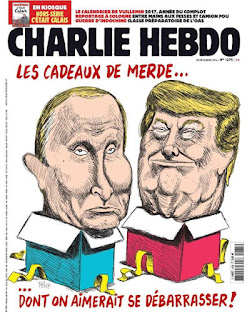
Riss’s Editorial
“Minds like a sieve” (Les têtes passoires, or Birdbrains)
“The execution in Milan of the author of the Berlin terrorist attack by the Italian police, instantly provoked the anger of the right and of the extreme right against the Schengen zone. For Florian Philippot, of the Front National: “Let us put an end to this sieve that is the Europe of the Schengen Area.” For Eric Ciotti, of the Republicans: “Europe has for a long time been a sieve-like Europe with no controls on its external borders; it is time for Europe to rearm.” And for Nigel Farage: “If the man killed in Milan is the terrorist from Berlin, then the Schengen Area is a risk for public security, and must disappear.”
Schengen to blame for terrorism… someone has to be to blame after all. Yet, as the JDD [NT: Le Journal du Dimanche is a weekly French Sunday newspaper] reminds us, the Schengen Agreement does not forbid reestablishing border controls. Since 1995, unhindered circulation has been suspended more than 20 times, and, in the case of “exceptional circumstances,” borders can be reestablished for a duration of up to 24 months. This is not the right argument, but it is, of course, always good to be seen to whack on Europe when we do not have anything else to say. The right-wing nationalists and the extreme right-wing parties rarely have satisfying explanations; they only have scape-goats. And, if possible, scape-goats who do not lift their voices up in protest. Like the various minorities—yesterday the European Jews, today the Roma and the immigrants. Likewise, the Schengen Agreement has the requisite quality to become the ideal scape-goat: it neither talks nor protests.
Schengen to blame for terrorism, is a con for another reason. In France, almost all of the terrorist attacks were committed by French citizens converted to Islamism. Good little French folks, born in France, grown up in France, and killing in France. What could borders have done against these?
The argument about the borders does not hold any water, so the right-wing nationalists try to make-do with immigration; because controlling the borders can no longer be the solution, immigration toward Europe must be prohibited. For a week now, in Germany, the AfD (NT: The Alternative for Germany, a right-wing populist political party) has been using this argument in accusing Merkel of being responsible for spilled blood because she allowed one million refugees to enter the country, among whom there were some terrorists. Welcoming such a large number of migrants in such a short space of time could not have been an easy job, and certainly carried some risks. But in an attempt to conquer new territories, Islamism is willing to forget about physical borders, because it is in minds that it first wishes to become established. No border guard can prohibit the internet from diffusing videos calling for stupid young French or Germans to join forces with Daech. We cannot build any border guard stations nor any barbed-wire fences, no matter how many miles in length, in the inside of heads. Sieve-like Europe does not exist; there are only sieve-like minds.
Just between France and Belgium there are more than 1500 points of entry or exit. In the brain of a young brainless kid, how many billions of gray cells would one have to control in order to keep Islamism from entering through the borders of his skull? Certainly more than 1500. When one is submerged by the multitude of minds contaminated by a totalitarian ideology, one is tempted to give up trying to convince them, one by one, to return to reason. Just like in the zombie movies, physical borders do not help in protecting yourself against them. The only alternative is to take a shot-gun and shoot them between the eyes. But, then, you really cannot say that out loud. And yet, supposedly, already 75% of the jihadists in Syria have been killed in fighting in the Middle East. But, officially, terrorists are still considered to be human, and our democratic societies have the obligation to treat them as such. In order to do this, centers for deradicalization had to be created—in order to save their souls from perdition, to be able to reestablish boundaries in their troubled minds, but this time between good and evil. Centers for deradicalization are like collection at mass, one puts a small coin in the offering plate to appease one’s conscience.
The military Chief of Staff is also passing an offering plate. He publically declared that the government needed to augment by 2% the part of the Gross Domestic Product [NT: PIB = GDP] dedicated to the Army, in order for the Army to have the means to continue the war against the zombies—or the terrorists, if you prefer. The war against the terrorists will not be won with border and border guards. Terrorists do not give a damn about borders. But then again, neither do the Rafales (TN: French military aircraft), which take off from the aircraft carrier Charles-de-Gaulle in order to eliminate those terrorists.”
Miscellaneous
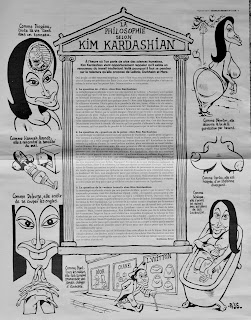
Cartoons from 18 January 2017
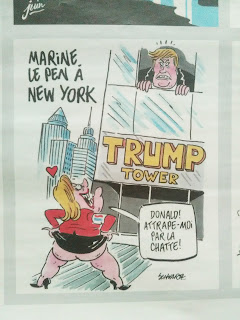
Kim Kardashian's philosophy
Further reading around Charlie Hebdo themes in Phrontisterion:
· http://nonimprimatur.blogspot.fr/2016/09/a-rousing-charlie-hebdo-rendition-of.html
· http://nonimprimatur.blogspot.fr/2015/12/paris-and-charlie-hebdo-enlightenment.html
· http://nonimprimatur.blogspot.fr/2015/11/paris-and-charlie-hebdo-wager-on.html
· http://nonimprimatur.blogspot.fr/2015/01/january-2015je-suis-charlie.html
· http://nonimprimatur.blogspot.fr/2016/02/heidegger-treacherous-millesime.html
· http://nonimprimatur.blogspot.fr/2015/02/the-divine-right-of-kings.html
· http://nonimprimatur.blogspot.fr/2015/03/enlightenment-and-spirit-of-jihad.html
· http://nonimprimatur.blogspot.fr/2015/11/from-eric-emmanuel-schmitt-question-on.html
· http://nonimprimatur.blogspot.fr/2016/04/martin-heideggeris-lady-philosophys.html
· http://nonimprimatur.blogspot.fr/2015/05/singing-good-and-evil-in-garden-of-lord.html
Reprised and reworked from original Phrontisterion translations published in January 2017.


